
Gogebic County Arrest Records and Court Charges
An arrest record is the account of the arrest itself. It captures who was taken into custody, which agency made the stop, the date, and the booking that follows at the jail. In Gogebic County the sheriff runs that custody side. An arrest, on its own, is not proof of guilt. It only means an officer believed there was cause to detain someone. The charge record is a different document. It reflects the formal accusations a prosecutor decides to bring once the case reaches the office.
The two records live in different places. Booking and custody detail sit on the jail side, so the roster and any booking information are covered on the Gogebic County inmate records page. The court charges after arrest sit with the court clerk, where each charge is logged, tracked, and updated as the case moves. Reading both together gives the full picture. The arrest shows why someone was held, and the charge record shows what the state chose to pursue.
How to Find Gogebic County Arrest Records and Charges
Charges filed after an arrest surface in the court case file, not on a jail blotter. Gogebic County does not run a standalone mugshot or booking database for the public, so the practical starting point is the court case search, where each filed charge, its code, and its current status appear once a case is open. The county routes misdemeanor and traffic matters through the 98th District Court and felony matters up to the 32nd Circuit Court, so the case type points you to the right search.
- Open the 98th District Court case search for local misdemeanor and traffic matters, or the statewide MiCOURT case search for a broader look across Michigan courts.
- Search by the defendant name or, if you have it, the case number. A case number ties the charges together across every hearing.
- Open the case and read the charge list. One case can hold several separate charges from a single arrest.
- Check each charge for its statute code, its severity level, and its current status before drawing any conclusion.
E-filed district civil and probate submissions run through the county's MiFILE system, which went live locally in late 2022. For older or non-digitized files that the portal does not show, a records request to the court clerk is the next step. The full case file, plea, and sentence live on the Gogebic County criminal court records page.
How Charges Get Filed in Gogebic County
The charge record begins after booking, when the prosecutor files a charging document with the court. That paper is what turns an arrest into a case. Michigan uses three main charging instruments, and which one appears depends on how serious the offense is and how the case reaches the court. Most local cases start with a complaint. Felonies then move up through a preliminary examination before a formal felony charge is entered.
| Complaint | Information | Indictment | |
|---|---|---|---|
| Filed By | Officer or Prosecutor | Prosecutor | Grand Jury |
| Common For | Misdemeanors and the first felony step | Felonies after bindover | Rare, serious cases |
| Court Level | 98th District Court | 32nd Circuit Court | 32nd Circuit Court |
| Role | Opens the case | Formal felony charge | Grand jury charge |
In a felony, the complaint and warrant start the matter in district court. The defendant is arraigned, and a preliminary examination tests whether there is probable cause. If the judge finds cause, the case is bound over to circuit court, where the prosecutor files the Information. A grand jury indictment is uncommon in Michigan, so most residents will see a complaint and then an Information rather than an indictment.
Gogebic County Charge Status Explained
A charge is not fixed. As a case moves, the prosecutor and the court can change it. A charge may be added, amended, reduced, dropped, or dismissed, and the case file records each shift. Reading the status field matters, because a charge listed at filing may look very different by the time the case closes. The terms below appear often in Michigan court records.
| Status | What It Means |
|---|---|
| Pending | The charge is filed and the case is still open, with no final outcome yet. |
| Amended / Reduced | The prosecutor changed the charge, such as lowering a felony to a misdemeanor. |
| Dismissed | The court ended the charge. It may be with prejudice, which usually blocks refiling, or without prejudice, which allows it. |
| Nolle Prosequi | The prosecutor formally chose not to pursue the charge and let it go. |
Note: A dropped or dismissed charge can still appear in the public case file, so an open record does not always mean an active or proven charge.
Charges vs. Convictions
Being charged is not the same as being convicted. A charge is an accusation the state must still prove. A conviction is the outcome after a plea or a verdict. This is the single most important distinction to keep in mind when reading any arrest or charge record, because the two carry very different weight.
| Charge | Conviction | |
|---|---|---|
| Stage | Accusation | Verdict or plea |
| Burden of Proof | Probable cause | Beyond a reasonable doubt |
| Meaning | Formally accused | Found or pleaded guilty |
| Public Record | Yes | Yes |
Gogebic County Charge Codes and Severity
Each charge is tied to a statute, usually a Michigan Compiled Laws section, so the code on the record points straight to the law the state says was broken. The severity level tells you which court hears the matter and how heavy the possible penalty is. A single arrest can produce several separate charges at once, each with its own code and its own status.
- Felonies: the most serious criminal class, charged in the 32nd Circuit Court.
- Misdemeanors: less serious offenses, handled by the 98th District Court.
- Civil infractions: non-criminal traffic or ordinance violations, which are not criminal charges at all.
- Multiple counts: one incident may yield a lead charge plus lesser related counts.
Because civil infractions are not crimes, a traffic ticket is a different animal from a criminal charge, even though both can trace back to the same stop. The 98th District Court Traffic Division handles the infraction side, while the criminal counts follow the charging path above.
Who Files Gogebic County Court Charges
Police make arrests, but they do not decide the charges. That call belongs to the Gogebic County Prosecuting Attorney's Office at 200 N. Moore St. in Bessemer. The office reviews the reports and evidence, then decides whether to charge, what to charge, and whether to seek a warrant. Its stated duties include criminal prosecution, victim restitution, child abuse and neglect prosecution, and warrant issuance when prosecution is pursued.
The prosecuting attorney is an elected county officer, and the person holding the seat can change over time, so questions about a specific charge are best directed to the office by phone at (906) 667-0471 rather than to any single name. If a charge decision is still pending after an arrest, the prosecutor's office is the right place to ask about timing. Gogebic County has no standalone public defender office, so requests for a court-appointed attorney run through the county court forms rather than a separate defender agency.
County Charges vs Federal Charges in Gogebic County
Not every charge that touches a Gogebic County resident is a county charge. Some cases are filed by federal prosecutors and never appear in the county court file at all. Gogebic County sits in the Western District of Michigan, Northern Division, and the practical federal courthouse for the area is in Marquette. Federal charges follow a separate track, with their own charging documents and their own docket system.
The U.S. District Court for the Western District of Michigan handles federal criminal and civil matters for the region, and its records do not live in the county courthouse.
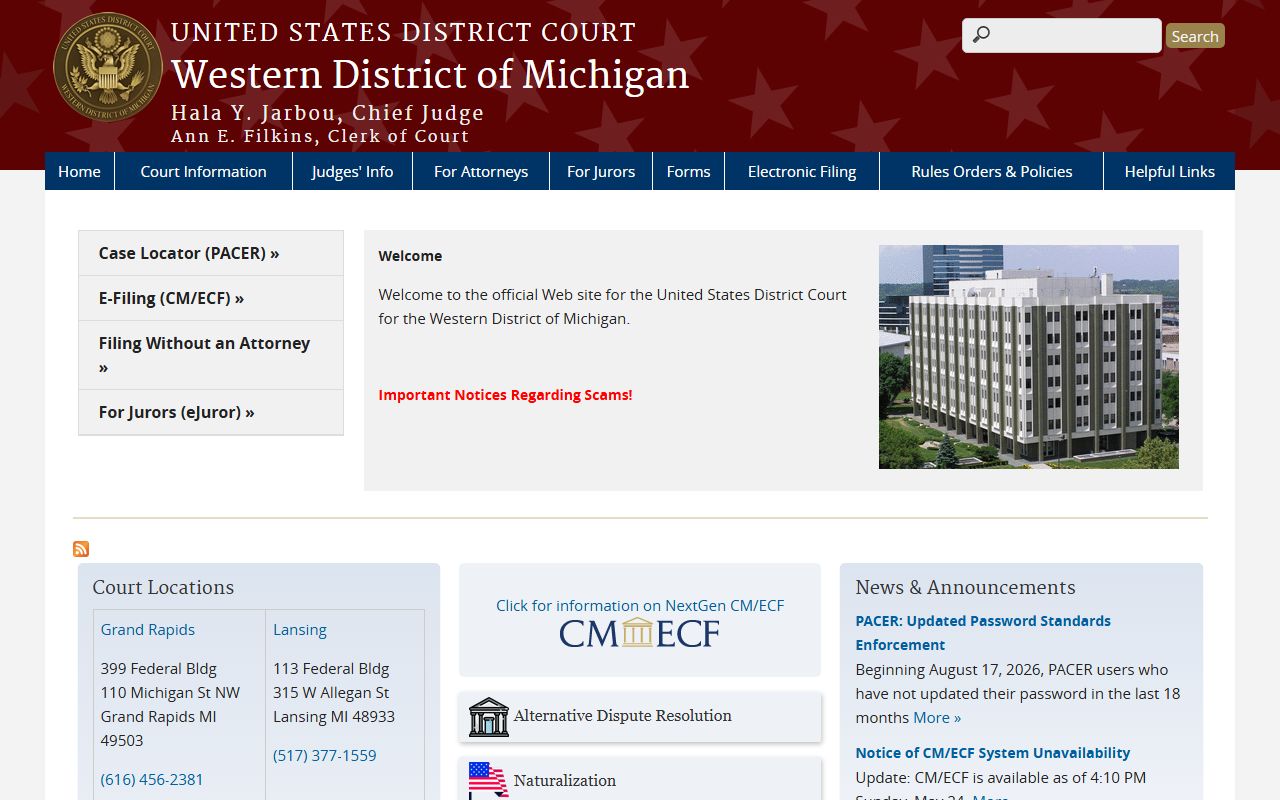
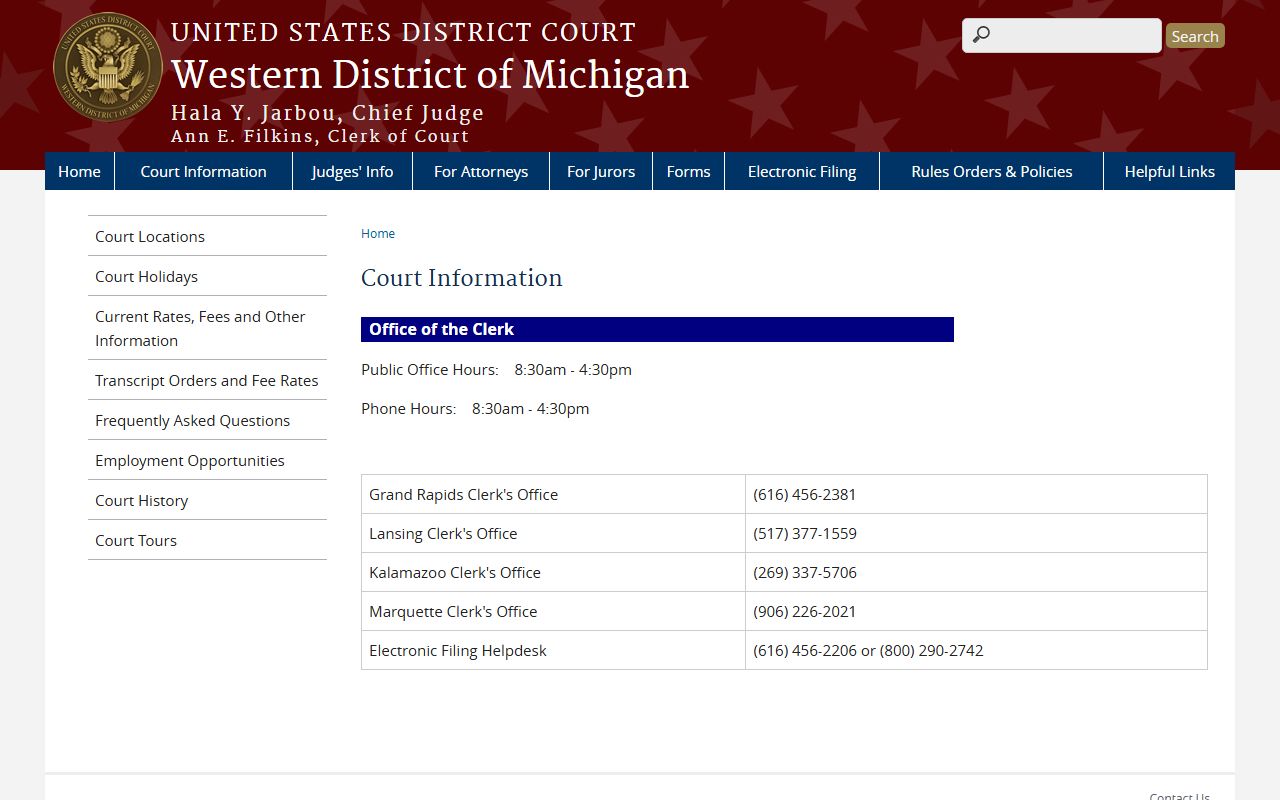
Federal charges are pursued by a U.S. Attorney rather than the county prosecutor, and the filings move through the PACER and CM/ECF electronic system instead of the county case search. The Western District court information page lists clerk office hours and the district's locations, including Marquette, Grand Rapids, Lansing, and Kalamazoo.
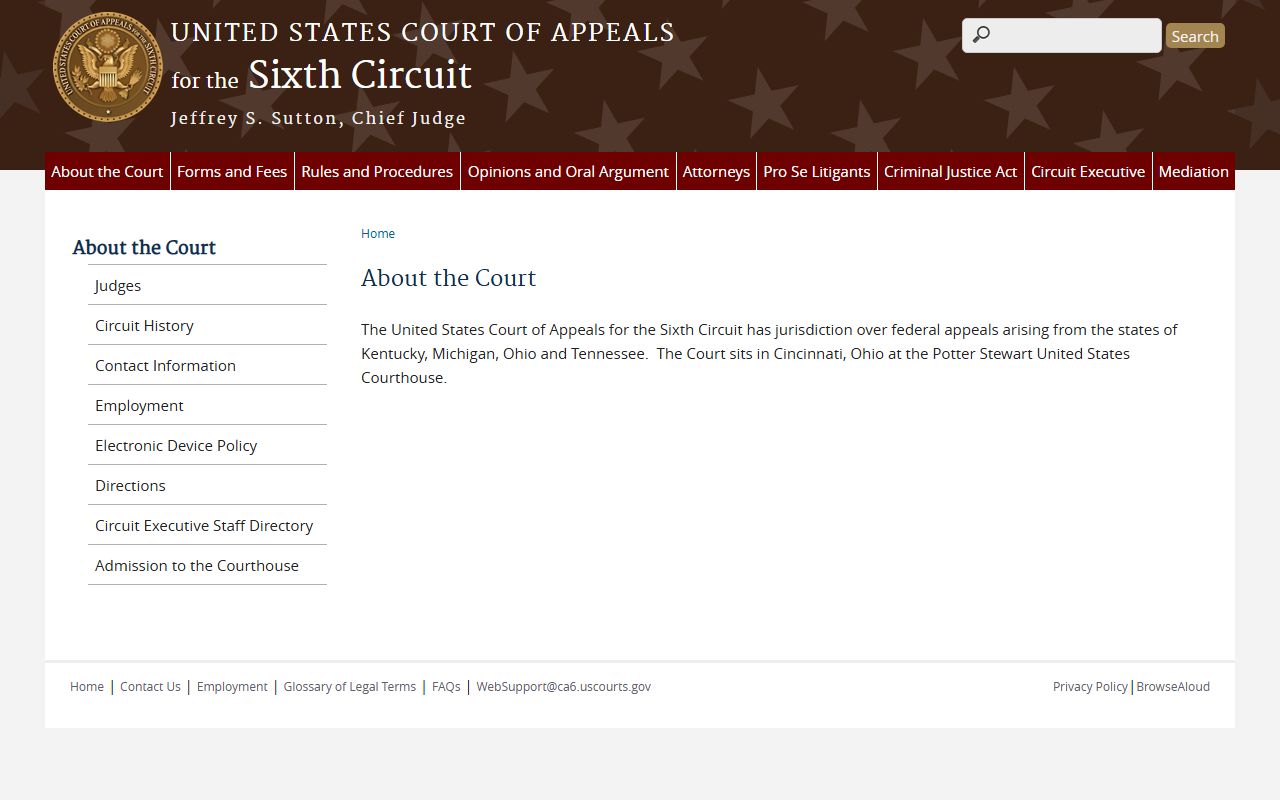
When a federal charge is appealed, the case goes to the Sixth Circuit rather than a Michigan appeals court. The Sixth Circuit Court of Appeals reviews federal appeals from Michigan, Ohio, Kentucky, and Tennessee, with its clerk in Cincinnati. That level split is why a county charge, a federal charge, and a state-prison custody record all read differently and cannot be checked in one place.
Keeping the levels straight saves time. A charge filed by the county prosecutor shows up in the 98th District or 32nd Circuit file. A federal charge shows up only in the federal system.
Statewide Charge and Criminal History Lookups
County charges are one slice of a person's history. To see how charges roll up at the state level, Michigan offers a few public tools, though each has clear limits. None of them is a full local arrest log, and each answers a narrow question.
- The MDOC Offender Tracking Information System (OTIS) tracks people in the state prison system. It plainly excludes county jail inmates, so it is not a Gogebic County jail lookup.
- The Michigan Sex Offender Registry is a separate public database limited to registrants.
- The statewide MiCOURT case search reaches many courts at once, but coverage depends on which courts have published to it.
For a formal criminal history background check, Michigan runs the ICHAT service through the State Police, which is the state-level path rather than a county service. A county charge record is the right source for the local case detail, and these state tools fill in the wider picture.
Sealed vs. Expunged Charge Records
Some charges leave the public view. Michigan law lets certain records be set aside, and court rules allow limited sealing when a judge finds it justified. The two are not the same. Sealing hides a record from public view, while an expungement, called a set-aside in Michigan, treats the matter as if it never happened.
| Sealed | Expunged | |
|---|---|---|
| Visibility | Hidden from public view | Set aside, treated as never existed |
| Law Enforcement | Limited access | Very limited access |
| Michigan Path | Sealing by court rule when justified | Set-aside under MCL 780.621, with some automatic under Clean Slate |
Note: The county site does not publish a local expungement fee sheet or step guide, so the controlling statute and the court clerk are the reliable starting points.
Gogebic County Background Check Notes
A casual name search is not the same as a regulated background check. Free court lookups are fine for personal curiosity or to follow a local case, but they are not built for hiring, housing, or lending decisions. Those uses fall under the federal Fair Credit Reporting Act, which requires a licensed consumer reporting agency and a permissible purpose. Michigan's ICHAT and a certified copy from the court are the proper sources when a decision has legal weight.
Important: This is not an FCRA-regulated consumer reporting agency, and its data may not be used to decide employment, housing, credit, or insurance.
Restricted Charge Records in Gogebic County
Not every charge is open to the public. Michigan law and court rule keep several categories out of the ordinary case search. Juvenile case records are maintained by the court and are open only by court order under MCL 712A.28. Adoption and mental-health treatment matters are treated as sensitive and do not sit on a public docket. Sealed and expunged charges drop out of public view entirely, and some hearings are marked nonpublic.
The wider access framework runs on Michigan's Freedom of Information Act. MCL 15.231 sets the public-records policy, while MCL 15.243 lists the exemptions a public body may withhold. Court records themselves are governed by court rule rather than FOIA alone, so a charge file follows both tracks.
Two local gaps are worth stating plainly. Gogebic County publishes no public warrant list or most-wanted page, so an outstanding warrant cannot be confirmed through an online county lookup. The county also runs no public mugshot or booking database. The reliable path for those questions is a direct call to the sheriff for custody and warrant execution, or to the court for bench-warrant status, rather than any online roster.