
Criminal Court Records in Gogebic County
A criminal court record is the case file the court opens the moment a prosecutor files formal charges. It is not the arrest report and it is not the jail booking sheet. It is the running account of everything the court does with a case: the charging document, each hearing, every motion and order, the plea or verdict, and the final sentence. In Gogebic County the clerk of the court that handles the case keeps this file, indexes it by case number, and adds to it as the case moves along. For a look at the charges by themselves, see the county arrest records and court charges page.
Two trial courts produce criminal case records here. The 32nd Circuit Court, shared by Gogebic and Ontonagon counties since 1891, is the general-jurisdiction court that hears felony cases, the most serious criminal charges. The 98th District Court handles misdemeanors, which are the lower-level offenses, along with the first steps of felony cases before they are sent up to Circuit Court. Traffic infractions, small claims, and civil suits under $25,000 also sit in the District Court. Both courts operate out of the county courthouse in Bessemer, and both feed the same statewide case-search system.
How to Search Gogebic County Criminal Court Records
Most criminal case information reaches the public through the state court system rather than a standalone county database. The 98th District Court page links straight to its case search, and the statewide Michigan court case search covers criminal, civil, traffic, and other case types depending on the court. The county warns that accuracy is not guaranteed and that a next-hearing field reading REVIEW does not mean a live hearing is set. To pull a criminal case record, follow these steps.
- Open the statewide case search or the 98th District Court case-search link from the county courts page.
- Enter the defendant's name, or the case number if you already have it.
- Narrow the results by court, case type, and filing date to find the right file.
- Open the case to read the docket entries, charges, hearing dates, and any disposition.
- Ask the clerk of the court that heard the case for a certified copy when you need one for legal use.
Older or non-digitized files may not appear online at all. When the portal comes up empty, the next step is a records request to the court that held the case rather than guessing at a case number. E-filed district civil and probate submissions run through the county MiFILE system, which went live in November 2022, and self-help kiosks in the courthouse help self-represented users start a filing.
Stages of a Gogebic County Criminal Case
A criminal case leaves a paper trail at each step, and the record grows as the case advances. Reading a file in order, from the charging document to the sentence, is the clearest way to understand where a case stands. The path is roughly the same whether a matter starts in the District Court as a misdemeanor or moves up to the Circuit Court as a felony.
Case flow: Charges Filed › Arraignment › Pretrial / Motions › Plea or Trial › Disposition › Sentencing
| Stage | What Happens |
|---|---|
| Charges Filed | The prosecutor files a complaint or information that names the defendant and lists each offense charged. |
| Arraignment | The first court hearing, where the charges are read and the defendant enters a plea and bond is set. |
| Pretrial / Motions | Both sides exchange information, file motions, and try to resolve the case; felonies pass through a probable-cause step before Circuit Court. |
| Plea or Trial | The defendant pleads guilty or no contest, or a judge or jury decides guilt at trial. |
| Disposition | The outcome is recorded, whether a conviction, an acquittal, or a dismissal. |
| Sentencing | On a conviction the judge imposes a sentence, which may include jail, probation, fines, or restitution. |
The Prosecutor's Role in Gogebic County Criminal Cases
Criminal charges do not come from the court or the sheriff. They come from the county prosecutor, who reviews police reports, decides what to charge, and carries the case through to disposition. The Gogebic County Prosecuting Attorney's Office works out of the courthouse at 200 N. Moore St. in Bessemer and can be reached at (906) 667-0471. Its duties include criminal prosecution, child abuse and neglect prosecution, child support establishment, victim restitution, and issuing warrants when a prosecution moves forward.
The county prosecutor's office page is the best starting point for how charging decisions get made in this county.
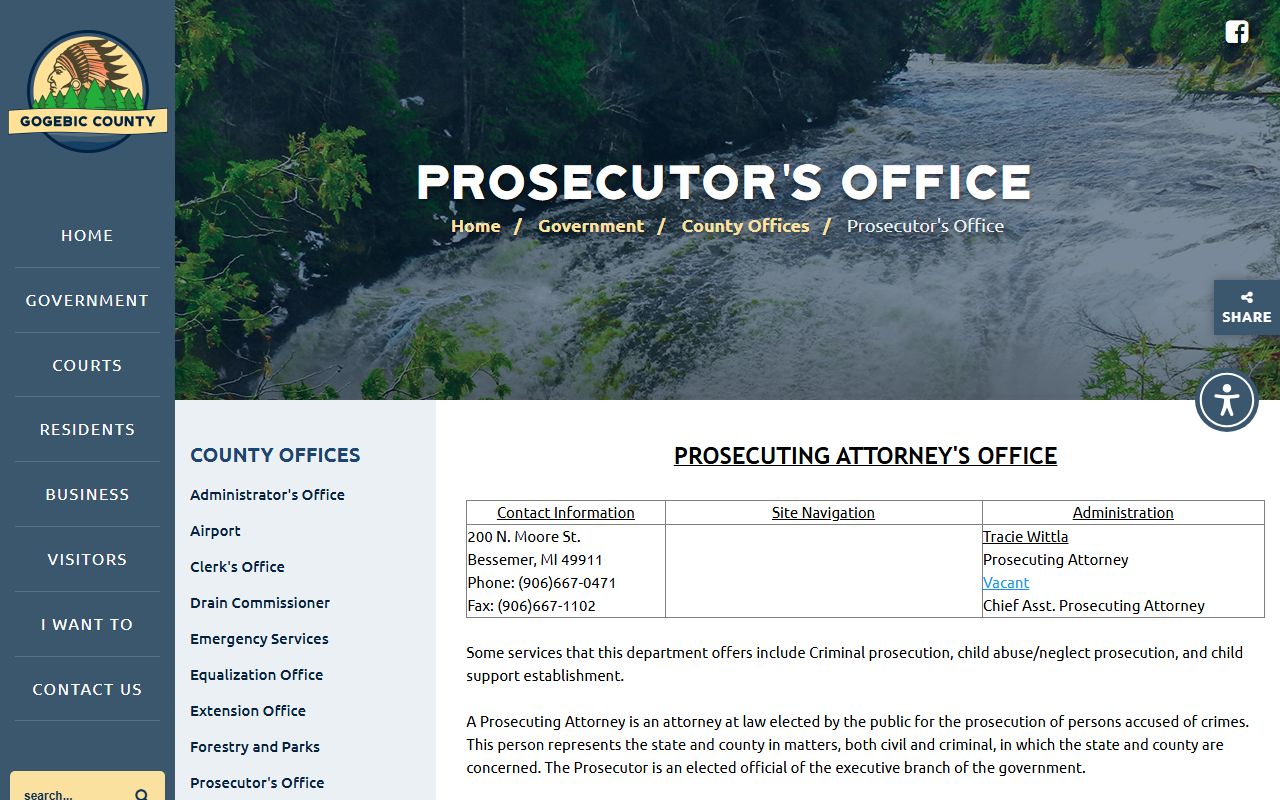
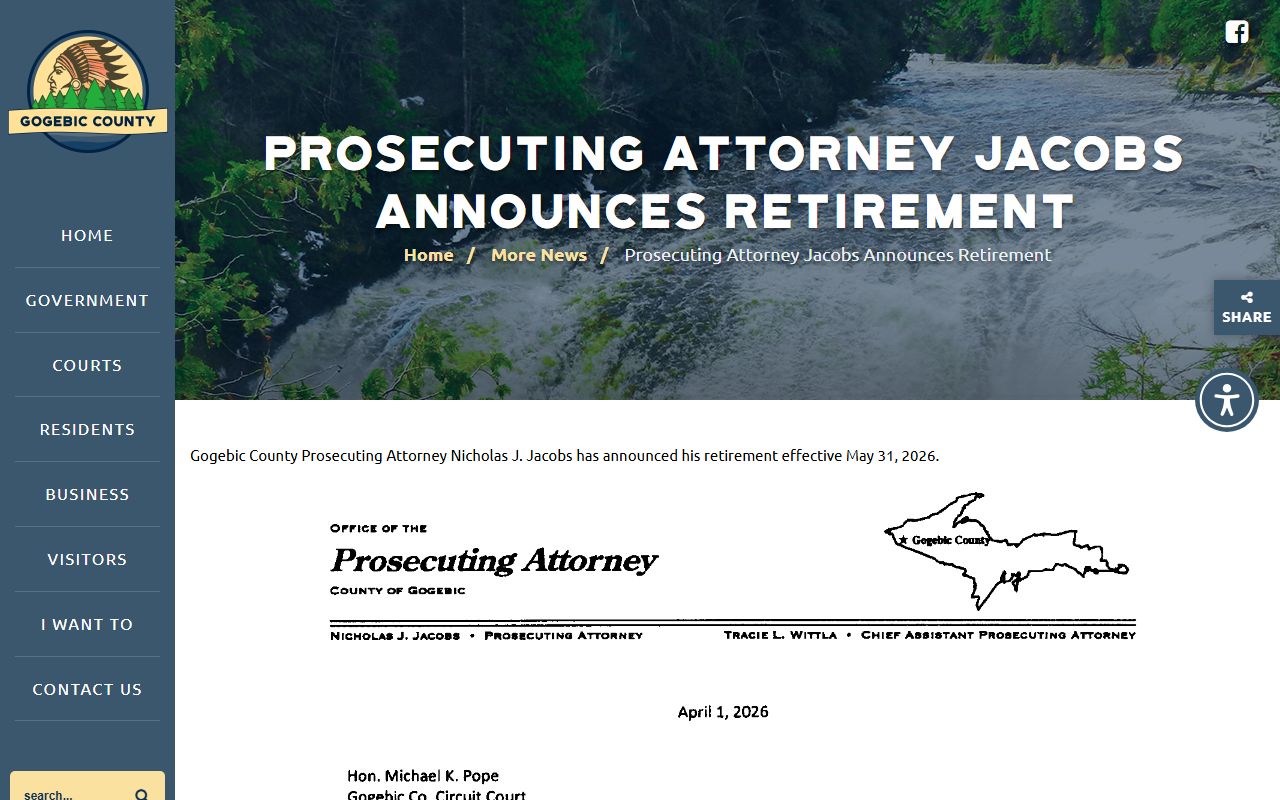
Leadership of the office has been in transition. The live office page lists Tracie Wittla, while a county news notice reports that Prosecuting Attorney Nicholas J. Jacobs announced his retirement effective May 31, 2026. Because the office is the source of every charge in a case file, its staffing matters to anyone following a matter, but the office and its phone line stay the same regardless of who holds the top job.
The county's prosecutor retirement notice documents that leadership change directly.
There is no standalone county public defender office. Defendants who cannot afford a lawyer ask for a court-appointed attorney using the county's Request for Court-Appointed Attorney, Financial Statement, and Fee Waiver forms, which sit on the court forms page.
What a Gogebic County Criminal Court Record Shows
A criminal case file is built from standard fields, and the same labels appear across the District and Circuit courts. Public case displays show the party name, hearing time, hearing information, case number, a case tracking number, and the court location. A case tracking number, or CTN, looks like a separate ID used alongside the case number on hearing calendars. The table below breaks down the fields that matter most when reading a criminal record.
| Field | What It Shows |
|---|---|
| Case Number | The court's unique ID for the file, used to pull the full docket. |
| Defendant | The person charged; the party the case is brought against. |
| Charges | Each offense listed on the complaint or information, with its severity level. |
| Plea | The defendant's answer to the charges: guilty, not guilty, or no contest. |
| Hearings | Scheduled dates and hearing types, such as arraignment, motion, or review. |
| Disposition | The outcome of each charge: convicted, dismissed, or acquitted. |
| Sentence | What the court ordered on a conviction, from fines to jail to probation. |
Not every line on a hearing calendar is a filed document, and a matter can be listed, moved, or later marked nonpublic. Full court records are governed by Michigan court rules such as MCR 1.109 and MCR 8.119, not by the Freedom of Information Act alone. The county court records page covers the wider record set beyond criminal files.
Charges vs. Convictions in Gogebic County Records
A charge is an accusation. A conviction is a finding of guilt. The two are easy to confuse in a case file, but they carry very different weight. A criminal court record can show charges that were later dropped, dismissed, reduced, or that ended in an acquittal, and none of those count as a conviction. Reading the disposition line for each charge, not just the charge itself, is the only reliable way to tell what actually happened.
| Charge | Conviction | |
|---|---|---|
| Stage | Accusation at filing | Verdict or accepted plea |
| Who Decides | The prosecutor | A judge or jury |
| Burden of Proof | Probable cause | Beyond a reasonable doubt |
| Can It Change | Yes, it can be amended or dropped | Only by appeal or set-aside |
| Public Record | Yes | Yes |
Note: A dismissal without prejudice can be refiled, while a dismissal with prejudice usually cannot, so the exact wording in the record matters.
Reading Dispositions and Sentences
The disposition is the court's answer to what happened with each charge. Common entries include guilty, not guilty, dismissed, and no contest, which is a plea that accepts the penalty without admitting guilt. Some cases resolve through a deferred or delayed outcome, where a defendant meets conditions and the charge is later dismissed. A sentence follows a conviction and can combine jail time, probation, fines, court costs, and restitution to victims.
Jail sentences of up to a year are served in the county jail, so they will not appear in the state prison system. Longer felony sentences go to the Michigan Department of Corrections, whose Offender Tracking Information System lists people in state prison and on parole but excludes county-jail inmates. The MDOC records FAQ explains how the state handles offender information and expungement.
That split means a single case can leave records in several places: the court file for the charges and sentence, the county jail for short terms, and the state system for prison terms.
Sealed vs. Expunged Criminal Records in Gogebic County
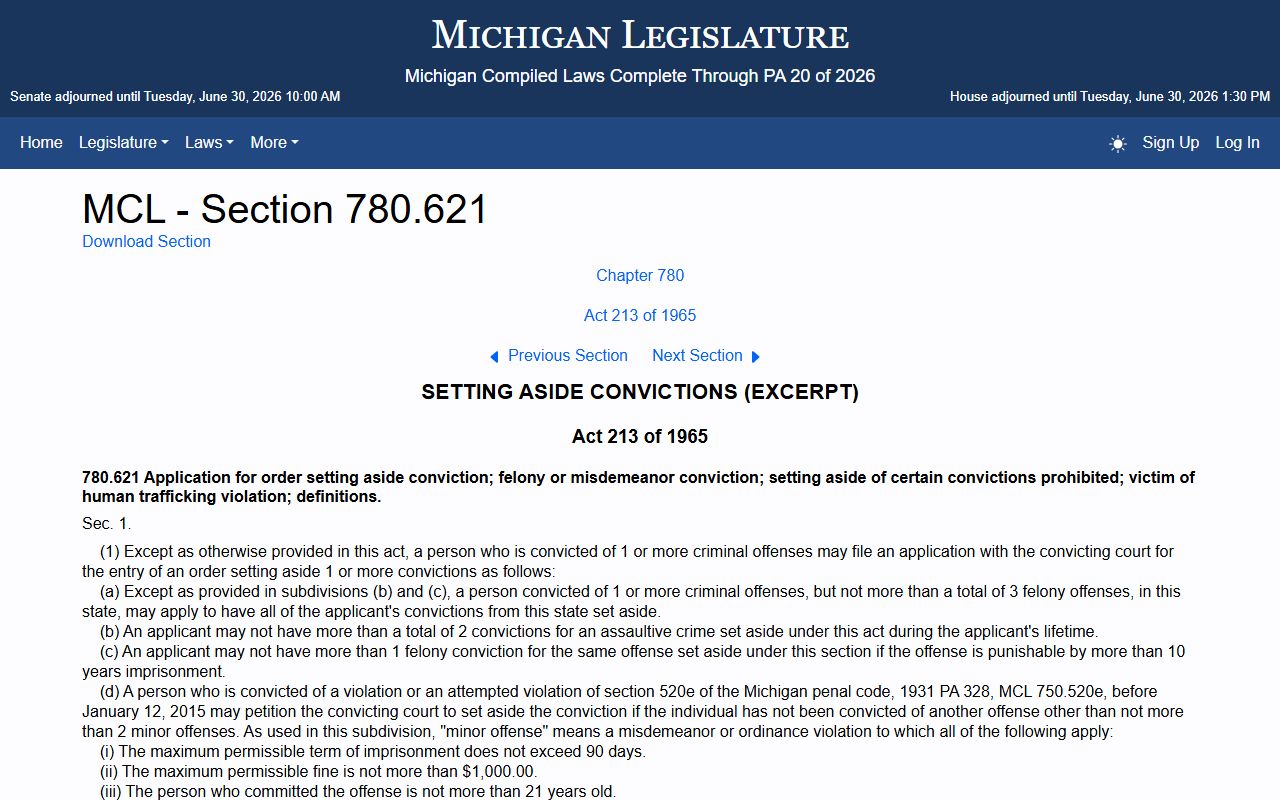
People often use the words sealed and expunged as if they mean the same thing, but they do not. Sealing restricts public access to a record while it still exists. Expungement, called a set-aside in Michigan, legally sets a conviction aside so it is treated as though it never happened. Michigan's expungement law is MCL 780.621, with companion sections that cover multiple offenses, prohibited offenses, timing, and automatic set-asides for some misdemeanors.
The Michigan expungement statute spells out how a set-aside application works.
| Sealed | Expunged / Set Aside | |
|---|---|---|
| Visibility | Hidden from public view | Treated as if the conviction never occurred |
| Law Enforcement | Limited access remains | Very limited access remains |
| Michigan Basis | Court rule and court order | MCL 780.621 set-aside statute |
| How It Happens | By court order in specific cases | By application, or automatically for some misdemeanors |
The county does not publish a local expungement fee sheet or step handout. A person usually needs the conviction details, the sentencing court, and a completed application, then must wait for the court's order. The state prison system says it clears its own records once it confirms the set-aside directly with the presiding court.
Public Access to Gogebic County Criminal Court Records
Most criminal case files are public in Michigan. County records are presumed open unless a statute or court rule says otherwise, and criminal dockets fall squarely in that open category. Court records themselves run under the Michigan court rules, so the court that holds a file controls how it is released, while the Freedom of Information Act governs the broader set of non-court county records. Sealed, juvenile, and expunged matters are the main carve-outs.
Key Statutes:
Michigan MCL 15.231 - the Freedom of Information Act policy that presumes county public records are open.
Michigan MCL 15.243 - lists the categories a public body may withhold from a FOIA request.
Michigan MCL 712A.28 - keeps juvenile case records open only by court order.
When an online search fails, a written records request to the clerk of the court that held the case is the reliable fallback. Copies and certified copies carry separate fee schedules, and the clerk can confirm whether an older file was ever digitized.
Restricted Criminal Court Records in Gogebic County
Some criminal-side records stay off the public docket. Juvenile cases sit in the Family Division of the Circuit Court, and under MCL 712A.28 those case records are open only by court order. Adoption and mental-health matters are handled as restricted as well, and some hearings can be omitted from public calendars or marked nonpublic. A blank public docket is not proof that no record exists; the file may simply be restricted.
Sealing under Michigan court rule is allowed only in limited, justified situations, and personal identifiers, information about minors, and protected financial details are commonly redacted before a file is released. For active investigations, warrant details may not surface until the court acts. A written records request to the clerk remains the surest route when a restricted or older file does not appear online.
Important: Criminal court records pulled from Michigan's public portals are for personal reference only and, under the FCRA, cannot be used for employment, tenant, or credit screening decisions.