
What a Gogebic County Court Docket Shows
A docket is the court's running case log. It lists each event in a case in the order it happened, from the first filing to the final order. Every time a party files a motion, the judge signs an order, or a hearing is set, a new line goes on the docket. The docket does not hold the documents themselves. It is the index that tells you what exists and when it happened.
That index is different from the full case file. The full file holds the actual motions, exhibits, orders, and transcripts. The docket only points to them. In Gogebic County, dockets and hearing calendars are produced by the 32nd Circuit Court, the 98th District Court, and the Probate Court, each of which keeps its own case log. A single line on a public calendar can name a party, a time, and a hearing type without revealing anything filed inside the case.
Reading the docket first saves time. It shows whether a case is active, closed, or waiting on a scheduled date.
The table below sets the docket beside the full record so the split is clear before you start searching.
| Docket | Full Case Record | |
|---|---|---|
| Format | List of dated entries | Filed documents and orders |
| Access | Often online through the state case search | May require a clerk request or in-person visit |
| Best use | Track case progress and hearing dates | Read the actual filings and rulings |
For the underlying filings and certified copies, the county Gogebic County court records path explains how to reach the clerk and the trial courts.
How to Find Gogebic County Dockets Online
Most Gogebic County docket and hearing-calendar information lives in Michigan's statewide case-lookup tools rather than a separate county page. The 98th District Court page links straight to its own case search, and the statewide Michigan case search covers civil, traffic, criminal, domestic, and probate matters depending on the court. The county reminds users that this search is a public service and that accuracy is not guaranteed.
Hearing calendars appear as court display pages that list the day's scheduled matters. You can view a live example of a court's daily public hearing calendar to see the format before you search your own case.
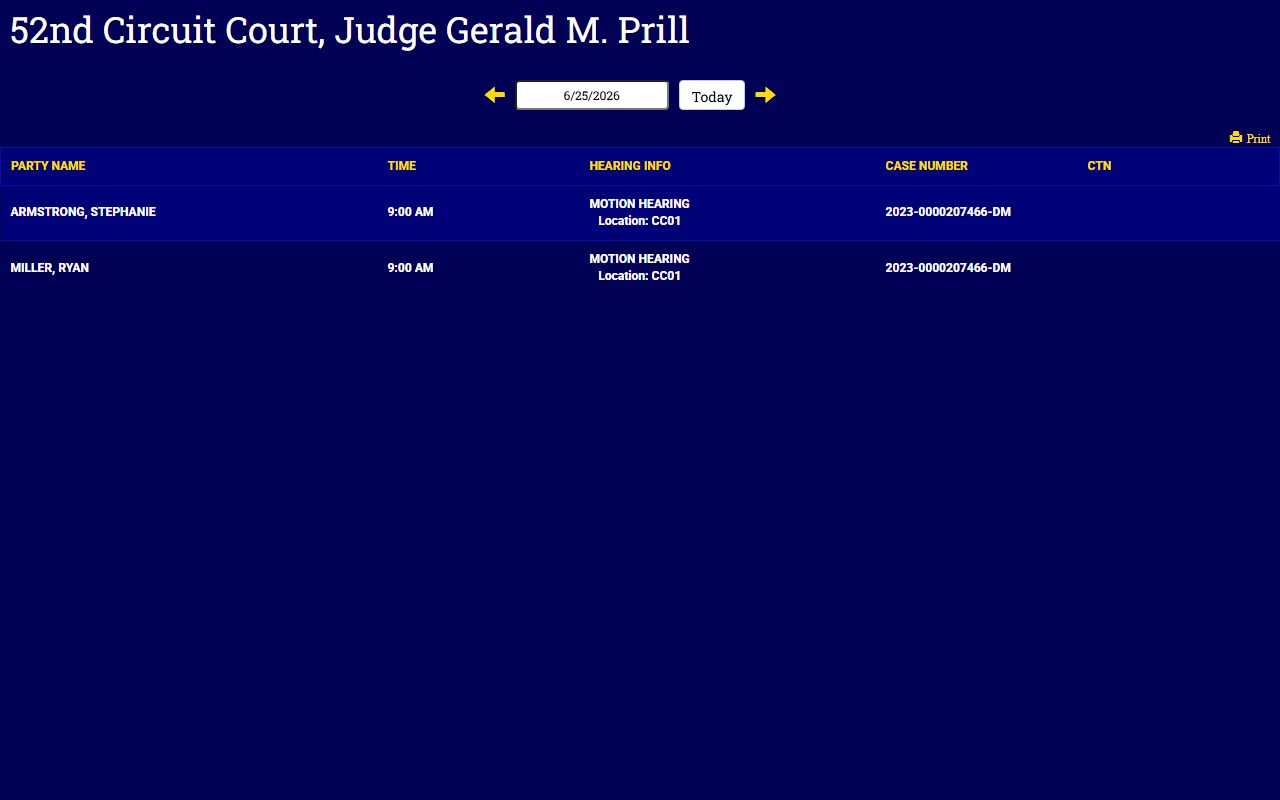
That calendar view shows how a docket display groups parties, times, and hearing types on a single public page, which is the same layout a Gogebic County user meets when checking a court date.
- Open the statewide Michigan case search or the 98th District Court case-search link.
- Pick the court that holds the case, since circuit, district, and probate matters are searched separately.
- Enter a party name or the case number, then run the search.
- Review the docket entries and any scheduled hearing, then call the court office to confirm details.
Note: If the portal does not show an older matter, the clerk's office is the next step rather than guessing at a docket number.
Sample Gogebic County Docket Entry
A public hearing-calendar entry packs several fields into one short line. The sample court display records captured for local and nearby Michigan courts show a consistent set of columns. You can open a real public court calendar record to compare the live fields against the breakdown below.
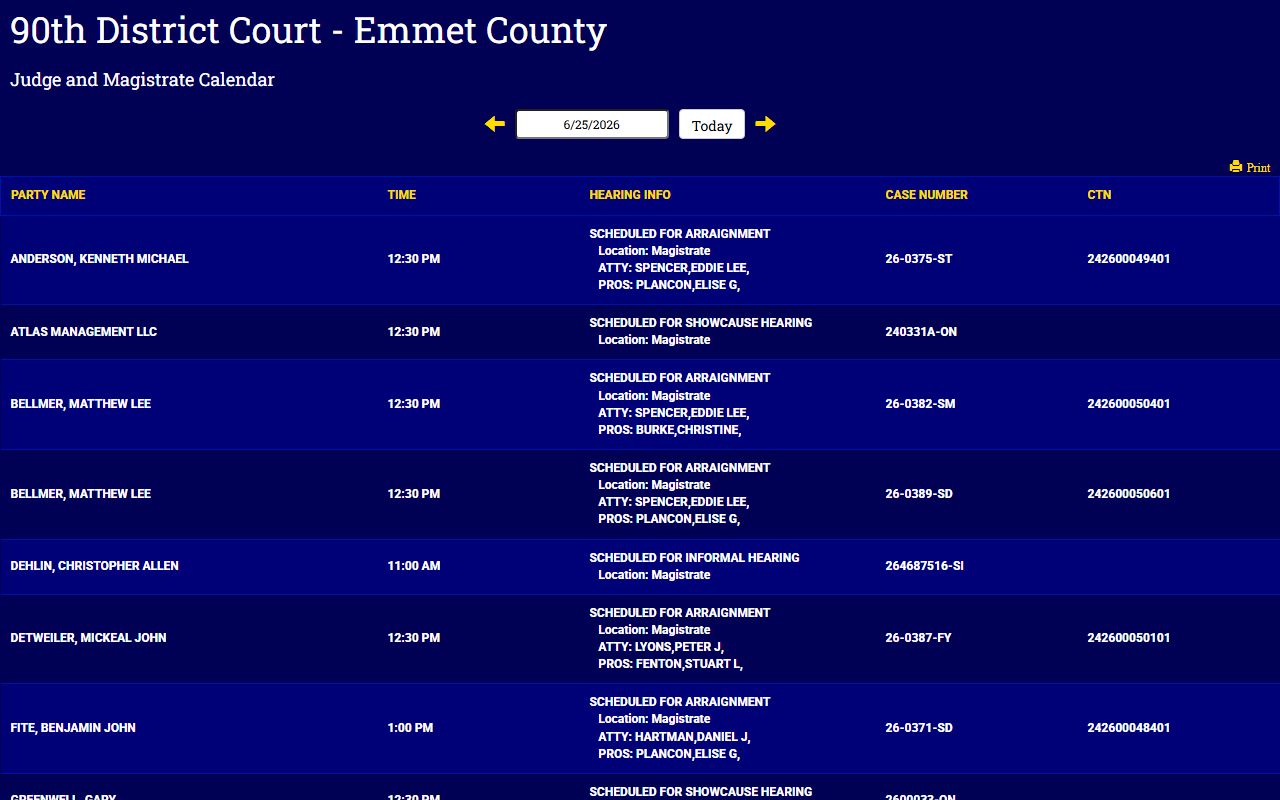
That display groups every scheduled matter under a party name and hearing time, which is exactly the structure a Gogebic County docket entry follows. Case numbers on these displays use a court-specific format such as 2023-0000207466-DM, where the trailing letters flag the case type. The table below explains each field you will see.
| Field | What It Shows |
|---|---|
| Party Name | The person or entity tied to the scheduled matter |
| Time | The scheduled hearing time, or a label such as "Today" |
| Hearing Info | The hearing type, such as Motion Hearing or Petition for Mental Health Treatment |
| Case Number | The court's file number, for example 2023-0000207466-DM |
| CTN | A tracking number listed alongside the case number |
| Location | The courtroom or court location for the hearing |
A docket entry is not always the same thing as a filed document. A calendar can list a matter that is later moved, removed, or marked nonpublic before the date arrives.
Why Some Gogebic County Hearings Say REVIEW
Not every docket line is a live courtroom event. The 98th District Court warns that when a case search shows REVIEW in the next-hearing field, there is no in-person hearing set at that time. A review is an internal check the court runs on the file, not a date you are expected to attend.
This trips up many first-time searchers. Seeing a future entry, they assume they must appear. The safer reading is to treat REVIEW as a status marker and confirm any real appearance directly with the court office before making plans.
Courts That Publish Gogebic County Dockets
Three trial courts generate the case dockets residents look for, and each keeps a distinct calendar. The 98th District Court page is the most direct starting point because it links its own case search and posts service notes about how its records work.
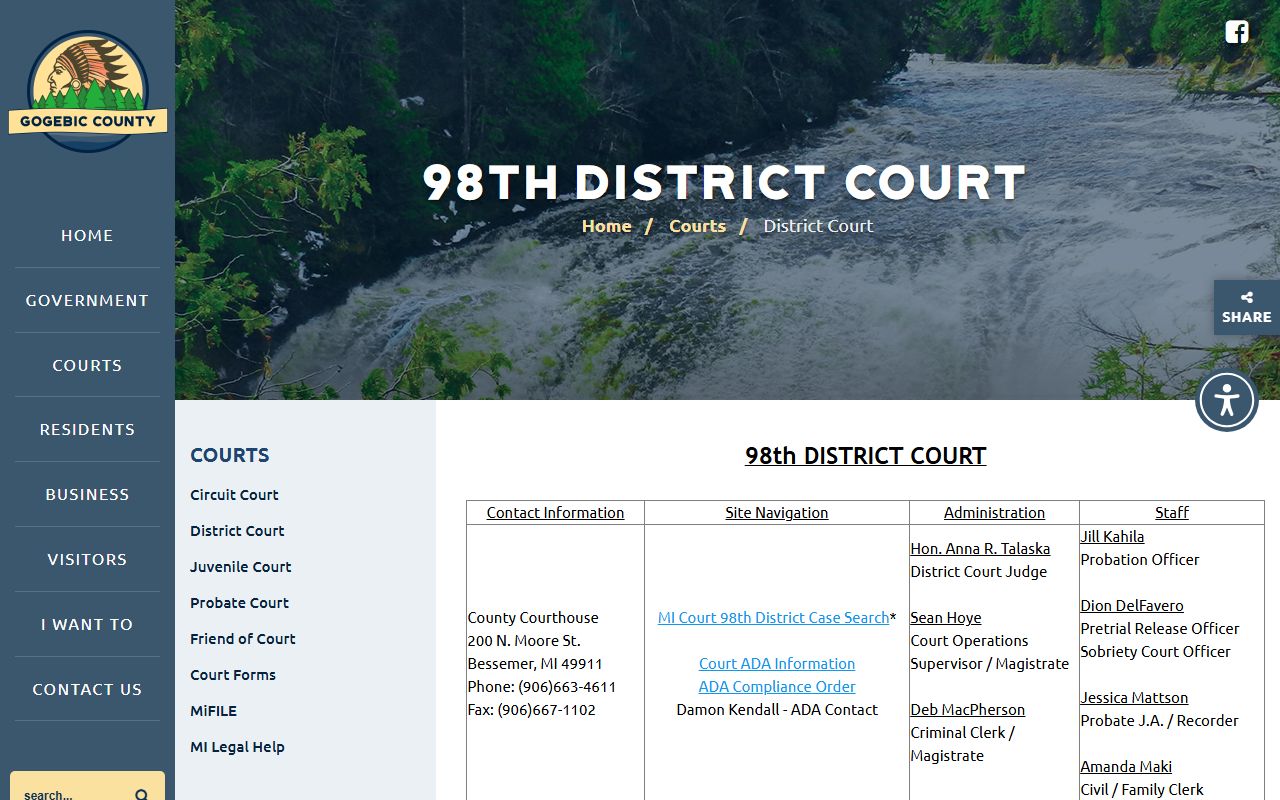
The district court page is where most day-to-day docket questions begin, since it carries the highest volume of traffic, misdemeanor, and small-civil matters. The three courts split the workload this way:
- 32nd Circuit Court: felonies, civil suits over $25,000, divorce and custody through the Family Division, and PPO cases across Gogebic and Ontonagon counties.
- 98th District Court: misdemeanors, traffic infractions, civil claims under $25,000, small claims, landlord-tenant matters, and probation.
- Probate Court: estates, guardianships, conservatorships, small estates, and mental-health treatment petitions.
Circuit and probate calendars often read differently from the district calendar because their case types run longer and involve more hearings. A felony case in circuit court can span many docket lines, while a traffic matter in district court may close in one or two.
Case Numbers and CTNs on Gogebic County Dockets
Two numbers often sit side by side on a public docket, and they are not the same thing. The case number is the court's own file identifier. The CTN is a separate tracking number that appears alongside it on hearing calendars. Confusing the two is a common reason a search comes back empty.
The case number is what you enter in the state case search. It is court-specific, so a district file and a circuit file use different formats even for related events. The definitions below cover the identifiers and labels seen most often on these displays.
- Case Number
- The court's file number for a matter, such as 2023-0000207466-DM, with trailing letters that flag the case type.
- CTN
- A tracking number listed next to the case number on public hearing calendars, used alongside the file number.
- Docket
- The court's running log of every event in a case, kept in date order.
- Disposition
- The outcome of a case once the court closes it.
When a case number does not return a result, checking the court type first usually fixes it. A circuit matter searched under the district court will not appear.
Nonpublic Hearings and Redactions in Gogebic County Records
Not everything on a court's calendar reaches the public display. Some hearings are marked nonpublic, and not all scheduled matters appear at all. Probate calendars in particular carry a docket note explaining that certain hearings are closed and that the visible list is not complete. You can view a sample probate hearing display and its nonpublic hearing note to see how the courts flag this.
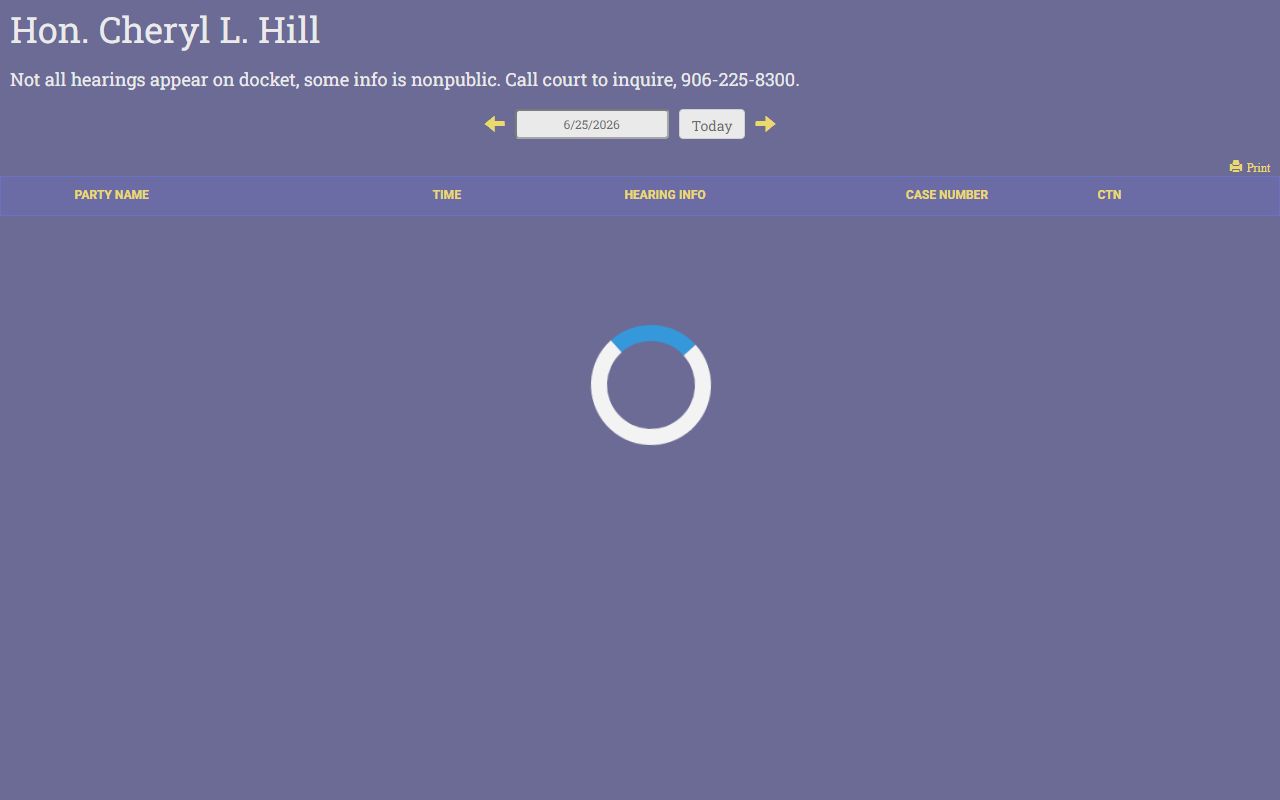
That probate display shows why a Gogebic County user may not find a scheduled matter even when a case is active. Juvenile identifiers, protected financial details, and sealed hearings are commonly redacted or left off the public view. Michigan handles this through both court rules and statute.
Court records are governed by Michigan court rules such as MCR 8.119, which sit alongside the state's public-records framework. Juvenile case records are held by the court and open only by court order under MCL 712A.28, and the FOIA exemptions in MCL 15.243 list categories a public body may withhold. Criminal matters that do appear are detailed on the county Gogebic County criminal court records path.
Note: A missing entry does not always mean a case does not exist, since nonpublic and sealed matters are removed from public calendars by rule.
How eFiling Creates Gogebic County Docket Entries
Modern docket entries increasingly start as electronic filings. Michigan's MiFILE system lets attorneys and self-represented filers submit court documents online, and each accepted submission generates a docket line in the case. When a motion or petition clears review, the court's log updates and the new entry becomes searchable.
Gogebic County moved onto this system in stages. The county MiFILE landing page explains how e-filing works locally, and the launch notice set the go-live date. You can read the county's own MiFILE launch announcement for the rollout details.
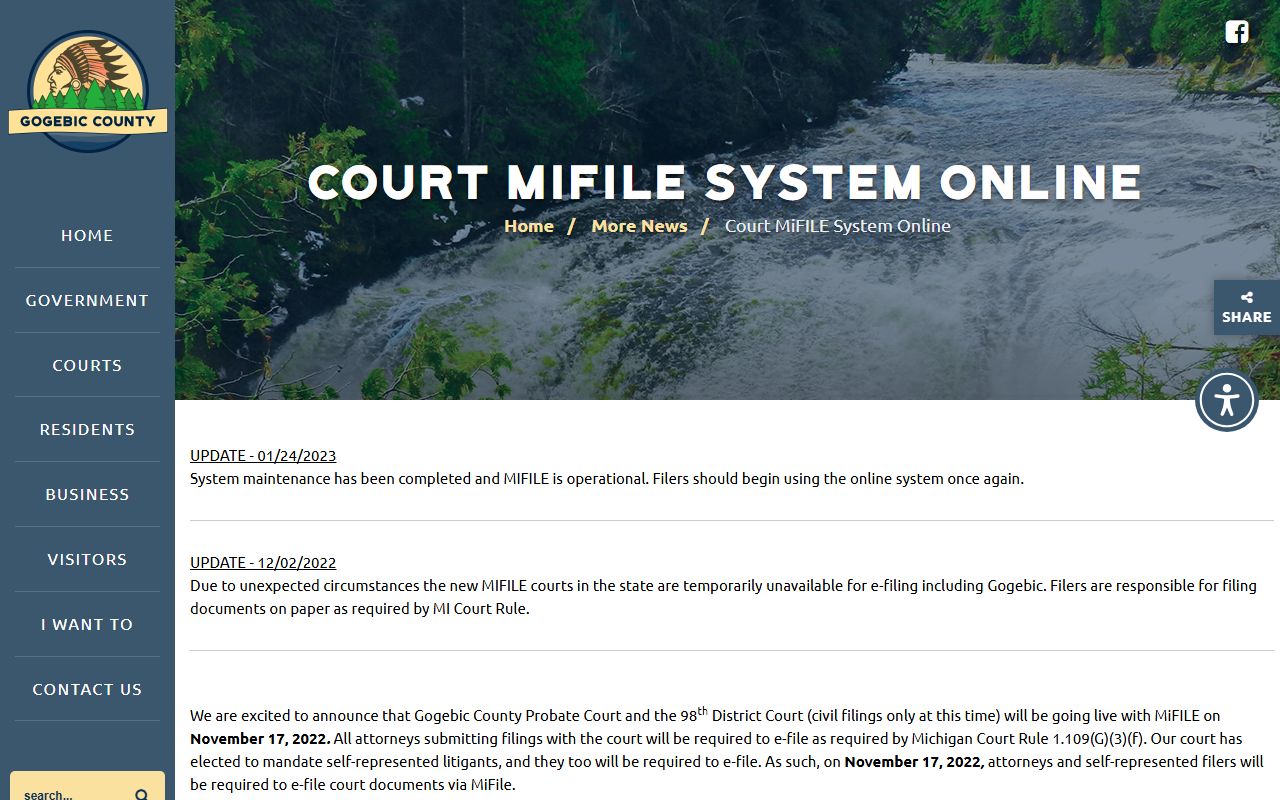
The notice confirms that Probate Court and 98th District Court civil filings went live with MiFILE on November 17, 2022, and that attorneys must e-file. The county also elected to require self-represented litigants to file the same way. Because each e-filed document posts to the record once accepted, the online docket now reflects new activity faster than the old paper-only process did. For matters MiFILE does not cover, or for older files, a clerk request through the county offices remains the way to reach the record.